

Larry King and RT: What Foreign Platforms Reveal About American Media Trust
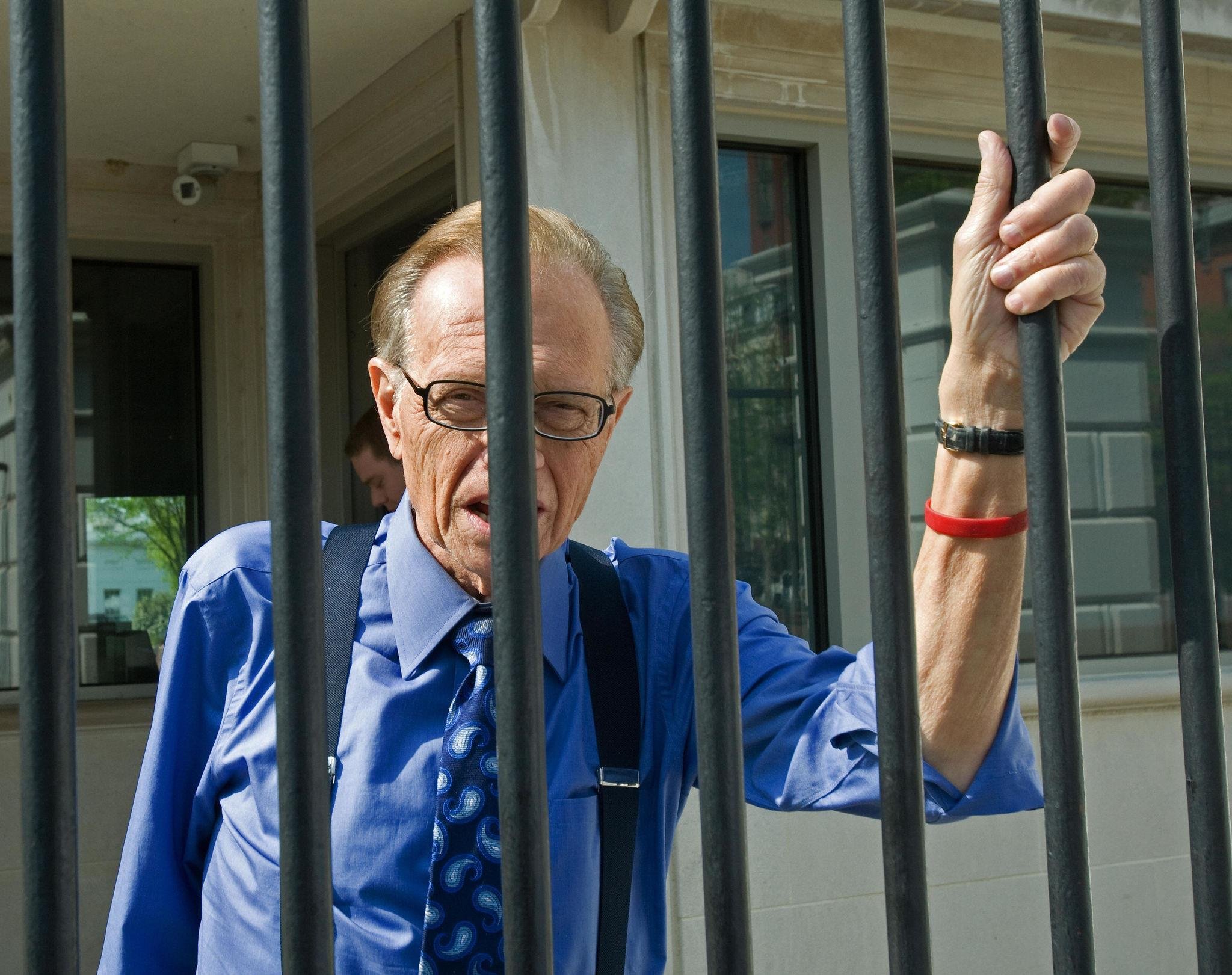
When Larry King died, I went looking for the funeral. Not the physical one but the media one. The long montage. The reverent panels. The network that had built itself around Larry King Live taking a night to say: This man was us.
What I remember instead was silence, or something close to it. A brief segment, a graphic, a passing acknowledgment. It wasn’t the flood you might expect for the anchor who, for a quarter century, was CNN at 9 p.m. Maybe my memory’s imperfect; the clips exist if you hunt them down. But the absence of a full-throated canonization felt conspicuous. It was as if the network had quietly decided that Larry King, in the end, belonged slightly less to them than to someone else.
By the time he died in 2021, King had spent years doing shows with Ora TV that were carried by RT America — a Russian state-backed outlet that used his familiar silhouette as part of its attempt to look less like an instrument of the Kremlin and more like another quirky node in the global talk ecosystem. King insisted he didn’t “work for RT,” that they were simply licensing his show. Still, the optics were indelible: the most recognizable face in American cable news history framed, in his final professional act, by a foreign state-funded network. Analysts at the Atlantic Council had already urged policymakers to recognize that RT is “a tool of the Kremlin, not an independent international broadcaster,” and that appearing on it makes one a tool of a hostile foreign power — a very different thing from just being syndicated on some obscure foreign channel.
So when he died, the question that lodged in my mind was not just, Why doesn’t this feel bigger? It was: When does working with a foreign platform quietly disqualify you from the story your own institution tells about itself?
That unease is a cousin of a broader irritation that flares every few months in American life: Why are so many foreign-born hosts, anchors, and comics lecturing America about America — often on American networks? Why do some voices get absorbed into the national narrative while others are treated as suspect, tainted, or disposable once they cross certain lines of foreign affiliation?
Larry King’s RT epilogue and the foreign-critic phenomenon sit on the same fault line: the uncomfortable, unspoken rules about who gets to narrate American governance, which platforms are considered legitimate, and where the boundary runs between “our” public square and someone else’s information war.
American politics is not a local product. Political theorist Susan Buck-Morss has argued that in a genuinely global public sphere, “defiance of state boundaries is practiced by diverse actors — labor immigrants and computer hackers, political refugees and [others]” — the point being that politics in one capital inevitably spills across borders. Washington’s decisions set interest rates rippling across continents, redraw climate targets, decide wars, enforce sanctions, and dictate the language of “democracy” that other governments are measured against.
That power means two things at once.
First, it makes American governance everyone’s business. A South African or Lebanese or British journalist who fixates on the U.S. is not trespassing on a neighbor’s yard; they are covering the nearest thing the modern world has to an imperial capital. That’s part of why foreign-born commentators have found such ready homes on U.S. television and streaming platforms. Their “outsider” status is a narrative asset: they can explain America to itself, and to the rest of the world, in one shot.
Second, that same power makes American media a target and a prize for foreign governments, parties, and billionaires who would like to launder their interests through American voices, formats, and brands. That’s the territory RT tried to occupy when it licensed Larry King’s show: not buying his politics so much as renting his aura, blending Russian state media with the muscle memory of CNN-era trust. Media scholars Mona Elswah and Philip Howard, dissecting RT’s internal culture, describe its mission in stark terms: “anything that causes chaos” in Western information environments, rather than some coherent editorial philosophy.
Analysts at Brookings, looking at the broader picture of Russian political warfare, describe the Kremlin’s “tool-kit of influence” as a 21st-century update of Soviet “active measures” — disinformation and propaganda campaigns, cyber operations, political infiltration, and the strategic use of corruption aimed at undermining trust in democratic institutions.
Americans feel both of these truths, often without naming them. So the reactions come out sideways.
We bristle at the British talk-show host hectoring Americans about the Second Amendment while cashing checks off our culture wars. We question the South African satirist who turns U.S. dysfunction into a global franchise. We side-eye the American legend whose later work runs on a Kremlin-backed feed.
We sense that something is being imported or weaponized, but we rarely distinguish between foreign participation in our public square and foreign control of it.
A 2015 YouGov poll on whether it was acceptable for a foreign citizen to host a show like The Daily Show found Americans “narrowly” saying yes — 41% acceptable, 34% unacceptable — with sharp age splits, a statistical snapshot of the ambivalence you can already feel in the discourse.
Those are not the same thing.
The way out of this muddle is to draw cleaner lines. One line is stake. If you live under American law — whether you were born in Ohio or Johannesburg — you have standing to criticize the government that taxes you, polices you, denies or approves your visa, shapes your health care, and educates your kids. Accent is irrelevant. A naturalized citizen or long-term resident is not a “foreign voice weighing in”; they’re part of the demos.
Another line is platform power. A foreign-born comedian doing U.S. political satire on an American network is not equivalent to a state-backed outlet — Russian, Chinese, Qatari, or otherwise — using American personalities to front its editorial project. The former is the ordinary churn of a pluralistic media market. The latter is a strategic choice about whose infrastructure you lend your credibility to, and in some cases, as the U.S. intelligence community and multiple think tanks have argued, part of a deliberate campaign to “undermine faith in the U.S. government and fuel political protest” rather than simply inform.
Larry King crossed that second line in a way that made a lot of people queasy, even if they couldn’t articulate why. It wasn’t that he kept working; it was where the work appeared. It was the sensation of watching a familiar American frame around an unfamiliar center of gravity. That may help explain why his memory sits in a strange limbo — fully honored by viewers, partially bracketed by the institution he made famous.
A third line is substance. Foreign or domestic, the real question is whether the critique is serious: grounded in history, informed by policy, alert to consequence. Many American-born pundits clear that bar less often than they think. Some foreign-born commentators clear it more often than they are given credit for. Nationality is a lazy proxy for rigor.
And beneath all this runs the question of narrative control: Who gets to tell the official story of what America is, what it’s doing, and whether it’s failing? That’s what’s really being contested when audiences sneer at “outsiders” lecturing them, or when a network quietly cools on one of its founding fathers once his image appears on a rival, foreign screen.
Seen from that angle, the debate over foreign voices criticizing American governance stops being a culture-war reflex and starts looking like a test of democratic confidence.
A confident democracy can tolerate: an immigrant host dissecting its institutions, a British journalist grilling its candidates, a South African comic skewering its hypocrisies, without spiraling into panic over purity. It can distinguish between critique that emerges from living inside the system and propaganda that emanates from outside it. It can recognize that global scrutiny is part of the price of global power.
A brittle democracy, by contrast, blurs everything together: foreign employee, foreign agent, foreign license, foreign threat. It rewrites its own legends when they consort with the wrong networks. It treats outsider commentary not as data to weigh but as intrusion to repel. It either overreacts — paranoid about anyone with an accent — or under-reacts, shrugging off obvious attempts to instrumentalize its discourse.
Larry King’s final act and its uneasy afterlife are a small, sharp reminder of how those instincts coexist. He was both indelibly American and, in the eyes of some, compromised by association. The same country that learned how to watch itself through his interviews had to decide whether, in the end, his image still belonged comfortably inside the frame.
The better question is not whether foreign-born commentators or cross-border platforms should speak about American governance. They already do, and they will. The question is whether Americans can tell the difference between participation and capture — between neighbors talking in the room and a sponsor buying the building.
In that distinction lies the real defense of the public square. And it is far more demanding than simply asking where a voice was born, or which channel once ran their show.