

From ‘Just Jokes’ to Real Harm: Islamophobia, Hit Pieces, and Mamdani’s New York
I’m not a New Yorker. I first visited with a friend who’d gone there for college. When we met, we bonded over my urge to go and her longing to return
We made a list, places to see, things to do, and she claimed the role of tour guide.
When we finally went, it was winter. The frigid city felt unmanageable: subway brakes shrieked, shoulders clipped mine, even the crosswalks seemed to hurry me along. Everything was everywhere.
We were going to see a rendition of Romeo & Juliet on Broadway. That was at the top of the list, above the landmarks, above the food. This version was Gen-Z and gleefully revisionist: multicultural, gender-swapped, race-swapped, starring Rachel Zegler. I was trepidatious. I like a classic Romeo and Juliet, intact iambic pentameter and doomed Verona and all that.
But there was something absurdly New York about watching one of the oldest love stories in the canon get cracked open and cast like the subway at rush hour.
On November 4, 2025, New Yorkers made history, electing Zohran Mamdani the city’s 111th mayor, the first Muslim and South Asian to hold the office. I won’t pretend I always saw it coming, but I recognized the look in his eyes, the same shine New Yorkers get when they talk about their home. As a forever fan looking in, it felt right that the city would be led by someone who still treats New York and her people as something rare.
New York’s multiculturalism is one of this country’s shining examples. Friday prayers spilling onto Atlantic Avenue, Diwali lights in Jackson Heights, Lunar New Year confetti in Flushing, the West Indian Day Parade roaring down Eastern Parkway, a hundred languages sharing a single subway car. That’s the miracle I keep looking at: a city stitched together out of difference, somehow making a single cloth.
Once you start really looking at New York, it becomes a little like learning the night sky. After a while you can tell what season you’re in by the angle of light on glass, which neighborhoods are arguing on the front page, which silhouettes anchor the horizon. Certain landmarks become your Orion’s Belt; the steady pulse of the subway is your Polaris. And then there are the tells that work like a civic summer triangle: the jokes people make, the images they choose, the names they underline.
Put those three points together and they show you which way the culture is facing. If you’re ever lost in the noise of a race like this one, you can follow those signals and see which way the conversation is trying to push you.
Which is why New York keeps becoming everyone’s business. What gets normalized in a city that exports media and culture often sets the tone for the rest of us.
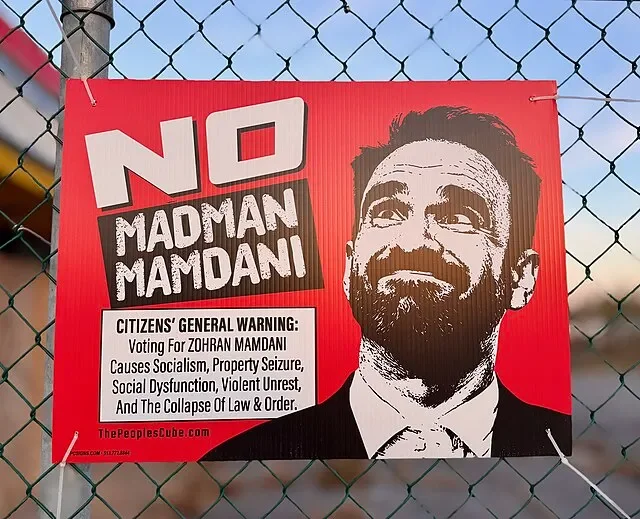
During Mamdani’s campaign, I watched a hit piece on him circulate, and the punchline wasn’t policy. It was about who he is. The framing didn’t say “Muslim,” but the winks did.
The visuals, the insinuations, the choice of what to magnify and what to crop, altogether it read like a dare: laugh with us, because it’s “just politics,” “just jokes.”
I keep thinking about how humor works in these moments. Social psychologists have studied disparagement humor for decades and the pattern is consistent: when people who already harbor bias are cued to treat group-based mockery as a joke, they become more tolerant of discrimination.
The joke doesn’t create prejudice from scratch; it licenses what’s there, lowering the social guardrails that normally keep us from saying or doing the thing. Thomas E. Ford’s work on prejudiced norm theory helped explain the mechanism.
Exposure to disparaging humor changes not what bigoted people believe, but what they feel newly permitted to express. We have seen this before. Jim Crow caricatures worked the same way. Minstrel shows and cartoons turned Black people into punchlines so often that cruelty began to feel like common sense. The joke came first; the justification for discrimination trailed right behind it.
Ford’s point is that disparagement humor works by creating a situational norm, a climate of tacit approval for those already inclined to look down on the target. Because the joke frames prejudice as light and unserious, it creates tolerance for conduct that would otherwise trigger a moral check. That is the norm of levity: once cruelty is smuggled in as comedy, the boundaries of what is sayable and doable quietly expand. And that norm has political consequences.
Recent research has found satire can damage reputations more efficiently than direct criticism because it flattens people into stock characters, exactly the effect campaigns bank on when they turn a person’s faith or name into subtext.
In the hit piece I saw, the edits were subtle, palette choices, b-roll selection, a narrator’s tone that softened for one candidate and sharpened for the other. Then the payoff: a line about “values” that didn’t say Muslim but I heard Muslim. The goal isn’t to state a slur; it’s to make the target feel culturally off, risky, foreign, laughable. If you can get me to snicker, you’ve moved me an inch. Fifty inches later, I’m somewhere I would’ve sworn I’d never go.
None of this was abstract in the race. Months before Election Day, a pro-Cuomo super PAC mailer reportedly used an altered image of Mamdani in which his beard appeared darkened and lengthened, prompting him to call it blatant Islamophobia.
The episode became a tell for how identity can be bent into caricature during the sprint for power. There is also mounting evidence that rhetoric ecosystems, especially on social platforms, can help nudge offline harm. Jokes are not the only ingredient, but they are part of the marinade.
Here at home, hate-crime levels remain high, and the post–October 7 atmosphere has been especially volatile, with both antisemitism and Islamophobia rising across public life. When campaigns tap identity as a cudgel, they are playing close to a live wire.
And what once felt theoretical now has a harder news peg. This past weekend, a far-right anti-Islam demonstration took shape outside Gracie Mansion, the official residence of Mayor Mamdani, turning his front gate into the latest stage for political contempt. Authorities say the protest was organized by Jake Lang.
The crowd itself was not enormous, but the symbolism was. New York’s first Muslim mayor had barely settled into office before his home became the site of a demonstration aimed not just at his politics, but at the identity many of his critics have been trying to make inseparable from them.
Then the atmosphere curdled further. Federal authorities say two men from Pennsylvania, Emir Balat and Ibrahim Kayumi, came to the scene with improvised explosive devices, one of which allegedly contained TATP along with screws, nuts, and bolts. Prosecutors say the pair were inspired by Islamic State, and they now face federal terrorism charges. The devices did not detonate and no one was injured. A separate protest participant, Ian McGinnis, was also arrested after authorities said he sprayed chemical irritants at counterprotesters.
Precision matters here. According to authorities, the explosives were allegedly brought by men tied to the counterprotest, not by the anti-Muslim organizers themselves. That distinction matters, because accuracy matters. But accuracy does not rescue the original obscenity of the scene. An anti-Islam protest outside the home of the city’s first Muslim mayor is not a policy disagreement in any serious sense.
It is a message. It says that for some people, Mamdani’s presence itself is offensive, that Muslim identity can be treated as inherently suspicious, and that public contempt can still be laundered through the language of speech, spectacle, and politics until something uglier arrives to feed on the mood.
That is what “just jokes” so often miss. The joke is rarely the end of the process. It is the softener. The solvent. The thing that makes harsher reactions feel newly sayable and newly survivable in public. First comes the wink, then the caricature, then the permission structure. After that, the actors may change, but the logic remains. One group arrives to taunt. Another arrives to escalate. Everyone insists their own side is merely reacting.
Meanwhile the city is left staring at a scene that would have sounded hysterical a year ago and obvious now.
Mamdani’s response sharpened the contradiction at the center of the whole affair. He condemned the demonstration and the violence around it while still defending the principle that even hateful protesters have the right to assemble. That is the burden of democratic leadership in a city like New York: to hold the line on liberty without lying about hatred.
So is the rise in racially and religiously insensitive humor a bad sign or a good one? I can imagine the optimistic case, that taboo-breaking signals we are airing tensions instead of bottling them up, that satire can punch up and expose hypocrisy. There is real scholarship showing subversive humor can challenge hierarchies when the audience understands the intent. But the line between puncturing power and punching down is thin, and in a campaign the incentives rarely reward nuance. The safer bet, and the one borne out by a great deal of research, is that “just joking” about identity normalizes contempt more often than it heals it.
What does that mean for the Mamdani era of New York? It means the question is no longer whether Islamophobia can be stirred through implication, mockery, and coded framing. It already has been. The better question is whether a city that prides itself on plurality can recognize the process before it hardens. When faith or race becomes the setup, the laugh often carries a permission structure that lingers long after the clip.
The downstream risk is real. Not because every joke becomes a crime, but because repeated contempt makes certain targets feel symbolically available.
I don’t think most voters want to be used that way. And I don’t think New York, loud, layered, allergic to sanctimony, needs to ban sharp humor to draw a firmer boundary. The standard can be simple: make the joke about what a candidate does and proposes, not who he is. If you have to lean on a congregation, a surname, or a beard to win favor, maybe you do not have much to say.
Back to that hit piece: I rewatched it, then read past the clip. I looked up the policy planks and the polling. I checked whether what I felt was actually happening in the race, or just happening to my limbic system. That extra minute didn’t make me a Mamdani booster or a cynic. It just made me harder to move by innuendo.
And something about that kind of looking always seems to cure whatever ails me. Part of it is the simple pleasure of paying real attention, of learning how the pieces fit. But it is also the relief of remembering that some things are bigger than any one news cycle or smear. New York is noisy and volatile and often cruel, but its deeper commitments, millions of people insisting on living side by side, arguing in a hundred languages, electing someone the jokes tried to make small, do not pivot on a punchline.
Once you’ve learned to see the patterns, you realize the worst campaigns can do is tug at your compass. They can’t move the true north of what kind of city, what kind of country, people are still capable of choosing. We will get some of it right and a lot of it wrong. We will love and lose and scroll and overreact. There will be more clips, more winks, more attempts to smuggle contempt in under the guise of humor.
But if we keep checking who the joke is trying to shrink before we laugh along, if we keep orienting ourselves by the signals that say everyone belongs or the project fails, then there is still a version of okay available to us.
I went into Romeo & Juliet suspicious and walked out a believer. I expected gimmicks on a sacred text; instead the production was fast, alive, and unexpectedly faithful to the emotional core. The casting jolted the story awake in a way I didn’t know I needed.
Seeing a balcony scene shaped by different bodies, accents, genders, and histories made the feud feel less like literature and more like the world outside the theater. It was shocking only because it exposed how narrow my default picture had been. For a play everyone thinks they know, this version proved there was still room to be surprised, and that expanding who gets to inhabit the classics isn’t a stunt. It is overdue.
That is the feeling I keep coming back to with Mamdani’s election. It does not solve everything. It does not magic away
Islamophobia or make campaigns noble. But it is one of those nights in the theater when the casting tells you what world you are in. Enough people in this city chose a version of New York where the kid at the TV glass, the Muslim name on the ballot, and the strangers in the balcony all belong in the same story.
For a place that has always been everyone’s business, I can’t think of anything more New York than that.