

The ‘Fake Jim Carrey’ Rumor and the Conspiracy Spell of the Internet
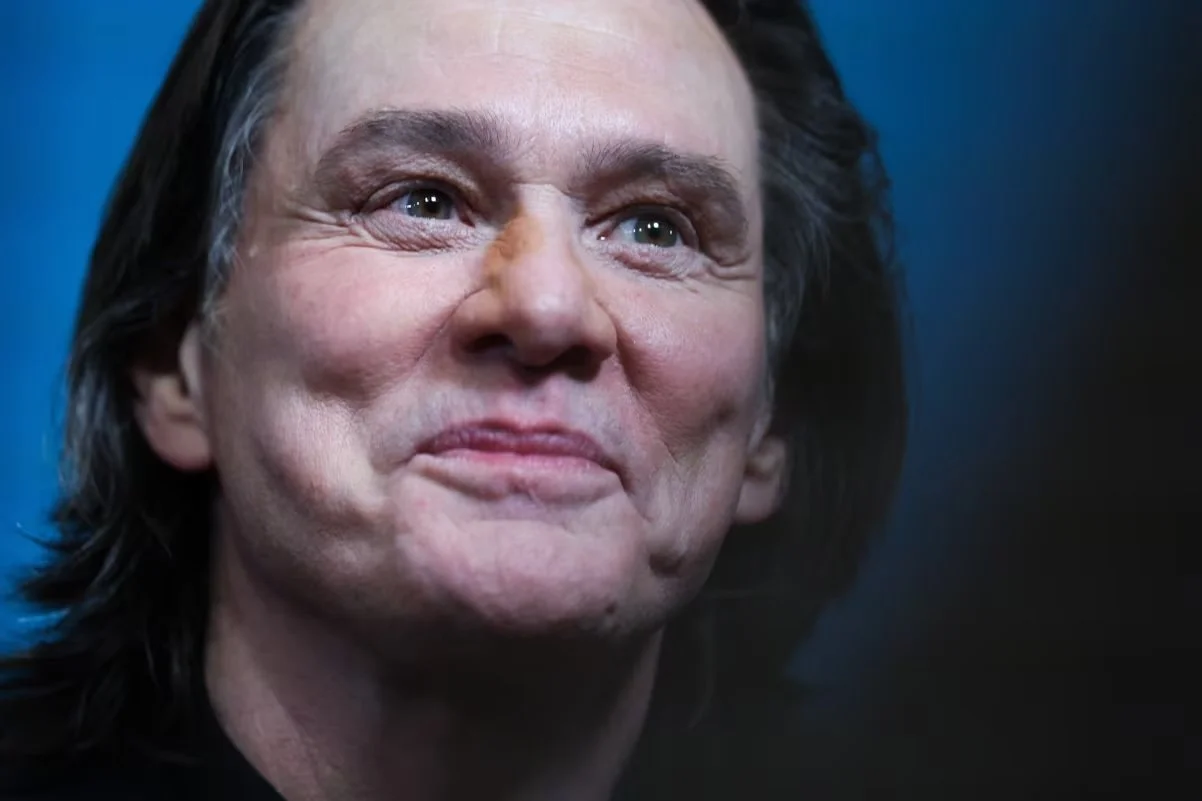
Fame does something strange to the human face. Beyond unforgiving lighting, the camera’s high-definition cruelty, the way a million people feel entitled to archive your pores—but the deeper thing: it turns your appearance into public property, a civic monument people expect to remain unchanged.
Plastic surgery sits inside that tension. Hollywood sells immortality as a product, then punishes anyone who tries to buy it. Get too much work done and you’re mocked as fake. Get none and you’re criticized for “letting yourself go.”
Either way, the public reads your face. When the “fake Jim Carrey” chatter caught fire, Jim Carrey was publicly accounted for in Paris—he had made a rare appearance at the César Awards on February 26, 2026, where he accepted an Honorary César and delivered remarks in French.
At the exact moment the internet started asking “Where is the real Jim Carrey?”, the boring answer was also the most verifiable one: he was in Paris, on a César Awards stage, accepting an honorary award in a rare public return. The conspiracy was born from a visual shock. He looked unfamiliar, sounded unfamiliar, and moved like someone the audience didn’t have a script for anymore. Organizers said the appearance had been planned for months and that he’d prepared the French-language speech over that time.
The specifics almost don’t matter, because what the internet responds to is visual discontinuity.
The eyes seem to sit in a new arrangement. The smile, once a weapon, now feels muted. People do what they’ve been trained to do online: they screenshot, compare, annotate, freeze-frame a human being into evidence.
The reason Jim Carrey is uniquely combustible in this environment is that he isn’t just a celebrity with a changing face. He’s a celebrity who, at various points, seemed to turn around and point at the machine while it was still running. He talked about the circus of fame as if he’d walked backstage and saw the ropes and pulleys.
He spoke about identity as performance, about “Jim Carrey” as something he wore, a character so successful the world mistook it for a person. When you tell the public that you’re a character, you don’t get to be surprised when they later wonder if you’ve been recast.
That’s the eerie symmetry of it: a man known for shapeshifting becomes the perfect canvas for a culture obsessed with replacement. Carrey’s entire artistic mythos—rubber-faced genius, spiritual skeptic, the comedian who suddenly started sounding like a philosopher—sets the stage for the conspiracy reflex.
People want to believe that someone who climbed that high can see something the rest of us can’t, and that if he speaks in riddles about the emptiness of fame, he must be hinting at a hidden architecture behind the world. In that hunger, his self-awareness becomes, paradoxically, proof of a plot. “He knows too much” is just “he’s lonely and I want meaning” wearing a trench coat.
So when an odd Instagram clip circulates of a man claiming he is Jim Carrey, or was him, or stood in for him, or is admitting to something, the internet doesn’t receive it like a joke.
People don’t ask, first, what this person might be doing for attention, or satire, or delusion, or performance art. It confirms and the public asks what it unlocks.
This is how the mass conspiracy spell works now. It requires a story that arrives at the right emotional moment, when trust is low, when algorithms reward paranoia, when the line between real and synthetic has been smeared by deepfakes and voice clones and endless edits, when everyone feels like they’re being managed by forces they cannot see.
In that atmosphere, “he looks different” is never allowed to remain a mundane observation.
Celebrities, especially ones like Carrey, are the perfect vessels for that narrative because they are both human and symbolic. We project onto them our private fears about time, about authenticity, about the gap between the life we’re promised and the life we actually get.
If a famous face can be altered, if a personality can be rebranded, if a person can vanish into their own public image, then what does that say about the rest of us? What does it say about identity in an age where everything is editable?
The cruel joke is that the “fake” story often comes from something completely ordinary. Botox doesn’t mean cloning. Cosmetic work doesn’t mean a switch was made in a secret room. Aging doesn’t mean a double took over.
It means a man’s face changed, as faces do, under more scrutiny than any face should endure. But the internet isn’t built to honor ordinary explanations. It’s built to take any small ambiguity and inflate it into a universe. The platform doesn’t ask, “Is this true?” It asks, “Will this travel?”
Carrey, in his strangest interviews, seemed to brush against that reality. He talked like someone who’d reached the mountaintop and discovered it was a ledge with a better view of the emptiness.
He made “Jim Carrey” feel like a suit that could be hung up. To some civilians watching from below, that sounded like enlightenment. It sounded like he was giving away forbidden knowledge, like he’d finally stepped beyond the veil and was describing what it costs to be adored by strangers.
And that, more than any meme or impersonator, is why the fake story persists. Because a culture that suspects everything will eventually believe anything, and a culture starved for meaning will treat any crack in the facade as proof that the whole building is rigged.
Jim Carrey doesn’t have to be cloned for the story to thrive. He only has to look unfamiliar for a second. The rest is the internet doing what it does best: turning discomfort into mythology, and mythology into a shared reality.
In the end, the conspiracy isn’t really about Jim Carrey. It’s about what happens when a society loses its ability to sit with uncertainty. The need to believe there’s always a secret door, always a hidden script, always a final explanation waiting just out of frame. For the modern mind, exhausted and overstimulated, a paranoid story is better than a complicated world where the answer is sometimes just… time.