

Alien “Species” People Report Seeing: Grays, Nordics, Reptilians
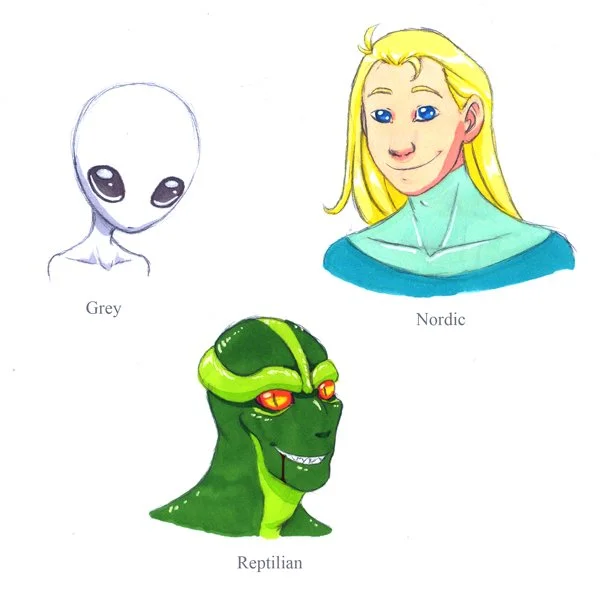
There’s a pattern in the way people describe the unknown.
Not just lights in the sky: bodies.
Faces. Hands. Voices that don’t move through air so much as through the mind. Across decades of UFO folklore and “close encounter” testimony, a recurring cast of alien “species” has formed: the Grays, the Nordics, and the Reptilians.
If you read enough UFO accounts, you start to notice something strange: the beings change outfits the way a culture changes its anxieties.
In the 1950s, the visitors were often handsome, calm, and almost human—space-age missionaries warning us about nukes. By the late 20th century, the visitors looked like clinical technicians—emotionless “Greys” running cold procedures under bright lights. And in the internet era, the visitors slipped into politics itself—“Reptilians” as a theory of hidden power, a monster wearing a human mask.
None of these categories are scientifically verified. U.S. government and NASA-facing reviews say they have not found evidence that UAP reports prove extraterrestrial technology or beings.
But as modern mythology—as recurring characters in thousands of testimonies—Grays, Nordics, and Reptilians have become the main “species” people claim to encounter.
Below is what witnesses say they saw, and what believers think the beings are here to do.
They’re not scientifically verified categories or a taxonomy. They’re storytelling—collective, persistent, and revealing.
And what’s most telling isn’t only what people say these beings look like. It’s what people believe they’re here to do.
The Grays: the clinical technicians of the modern myth
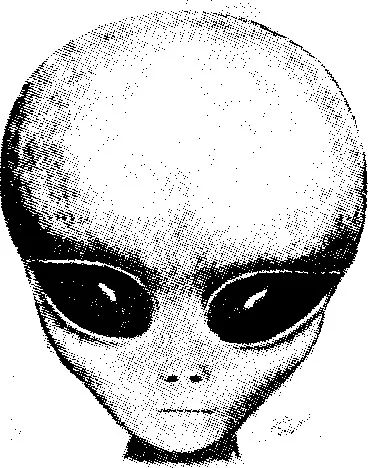
If the alien narrative has a default face, it’s the Grey: smooth head, oversized black eyes, thin body—an anatomy built like a question mark.
In witness accounts, Grays are rarely described as curious or chatty. They don’t arrive like tourists but like staff.
The tone of these stories is fluorescent and procedural: bright rooms, tables, instruments, restraint, missing time, a memory that returns in fragments like a dream that refuses to stay buried.
Many of the most famous abduction narratives, especially in American pop culture. These helped lock in the “Grey encounter” template: the visitor as clinician, the human as subject.
Even when the details shift, the mood stays consistent: the cold choreography of examination.
What witnesses and believers think the Grays are here to do
Across testimonies, a few motives repeat so often they’ve become a kind of unofficial script:
Biological sampling and “medical” procedures.
People report examinations of the body, internal scanning, and invasive procedures—sometimes experienced as literal events, sometimes described with the surreal texture of sleep paralysis or dream memory.
A “hybrid program”
A persistent claim in abduction lore is reproductive experimentation: the extraction of genetic material, forced reproduction, or being shown hybrid children—as if humanity is part of a long project, not a conversation.
Data over dialogue
Communication is often described as telepathic and minimal: not a speech, not a debate—an instruction, a command, a message that feels more like an upload than a sentence.
Being Centered read:
The Grey story is the nightmare of modern life made cosmic, your body as paperwork, your mind as a folder, your consent as something “processed” rather than respected.
The Nordics: the space-brother myth of beauty and warning

The Nordics are the opposite energy.
Where Grays are sterile and surgical, Nordics are described as radiant, human-looking, calm—sometimes tall, often “beautiful,” and frequently framed as morally or spiritually elevated. In these stories, the encounter leans less toward abduction and more toward contact: the visitor as messenger, not mechanic.
This archetype gained traction in the mid-century “contactee” era—when UFO narratives often felt like spiritual parables or Cold War sermons. The message wasn’t “you’re being studied.” It was “you’re being watched—and you’re playing with fire.”
What witnesses and believers think the Nordics are here to do
Warn humanity about self-destruction (especially nuclear war)
Many Nordic-style accounts revolve around a recurring fear: that humanity’s violence is loud enough to echo beyond Earth.
Steer human consciousness
These stories lean toward spiritual evolution: grow up, stop warring, stop poisoning the planet, stop worshipping domination.
Nudge without forcing
Nordic narratives often emphasize consent, dialogue, and guidance—less “experiment” and more “intervention,” though usually framed as gentle.
Being Centered read:
The Nordic is the fantasy that the universe has an adult in the room—a being who’s powerful but not cruel, corrective but not controlling.
The Reptilians: the political demon of the internet age
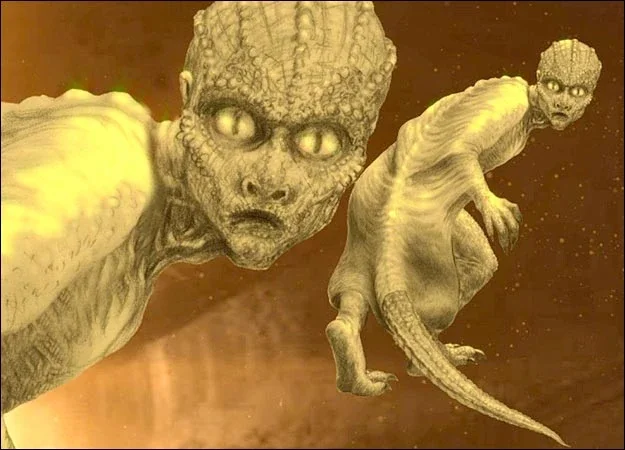
Reptilians don’t show up as frequently in classic “I saw a craft” reports. They show up as an explanation for power.
This archetype is less a witness encounter and more a worldview: reptilian humanoids, sometimes shape-shifting, sometimes interdimensional—hidden in plain sight, sitting in boardrooms, wearing human faces like suits. The story travels through conspiracy culture as a totalizing answer to a modern feeling: systems are cold, leadership is theatrical, and the people at the top seem… not quite human.
Reptilians aren’t just aliens in this mythology. They’re the reason.
What witnesses and believers think the Reptilians are here to do
Control institutions
Government, finance, media—capture the levers, steer the narrative, keep the public dizzy.
Rule through fear, division, and confusion
In many versions, the goal isn’t simply domination—it’s emotional management: keep people suspicious, exhausted, fighting shadows.
Hide reality inside spectacle
The Reptilian myth thrives on the idea that truth is buried under performance—politics as theater designed to hypnotize.
Being Centered read:
The Reptilian is what a power-starved society invents when it can’t locate accountability. When the machine feels inhuman, the mind imagines an inhuman operator.
The mission sets: what people most often think “they” are doing here
Across these archetypes, the motives cluster into a few recurring “job descriptions”:
1. Surveillance and study (Grays as technicians; humans as specimens)
2. Genetics and reproduction** (hybrid narratives; lineage anxiety)
3. Warnings and guidance (Nordics as moral correctors; nukes as a cosmic alarm)
4. Control and covert rule (Reptilians as the face behind institutions)
It’s striking how rarely the dominant lore imagines aliens as simply curious. The stories we repeat tend to be either clinical, spiritual, or political—as if the only plausible reasons to cross galaxies are the same reasons humans cross borders: research, religion, or power.
Being Centered read:
These aren’t just alien stories. They’re human stories wearing alien masks—our fears about bodies, our longing for meaning, and our suspicion that power is secretly predatory.
Reality check: the difference between testimony and evidence
None of these “species” categories are established by science. They’re cultural archetypes built from decades of reported experiences, media feedback loops, and the strange persistence of shared imagery. Official investigations and public-facing reviews of UAP reports have repeatedly emphasized that many cases lack sufficient data to reach firm conclusions—and that unresolved cases are not the same thing as proof of extraterrestrial beings.
But “not proven” doesn’t mean “not believed.” And belief has its own ecosystem: testimony, community, pattern recognition, mythology, and the emotional relief of a story that explains the unexplainable.
Being Centered read:
The truth might be out there—or it might be inside us. Either way, the “species” we see tend to match the era we’re living through.