

UFOs Went Mainstream. That May Not Mean They’re Aliens.
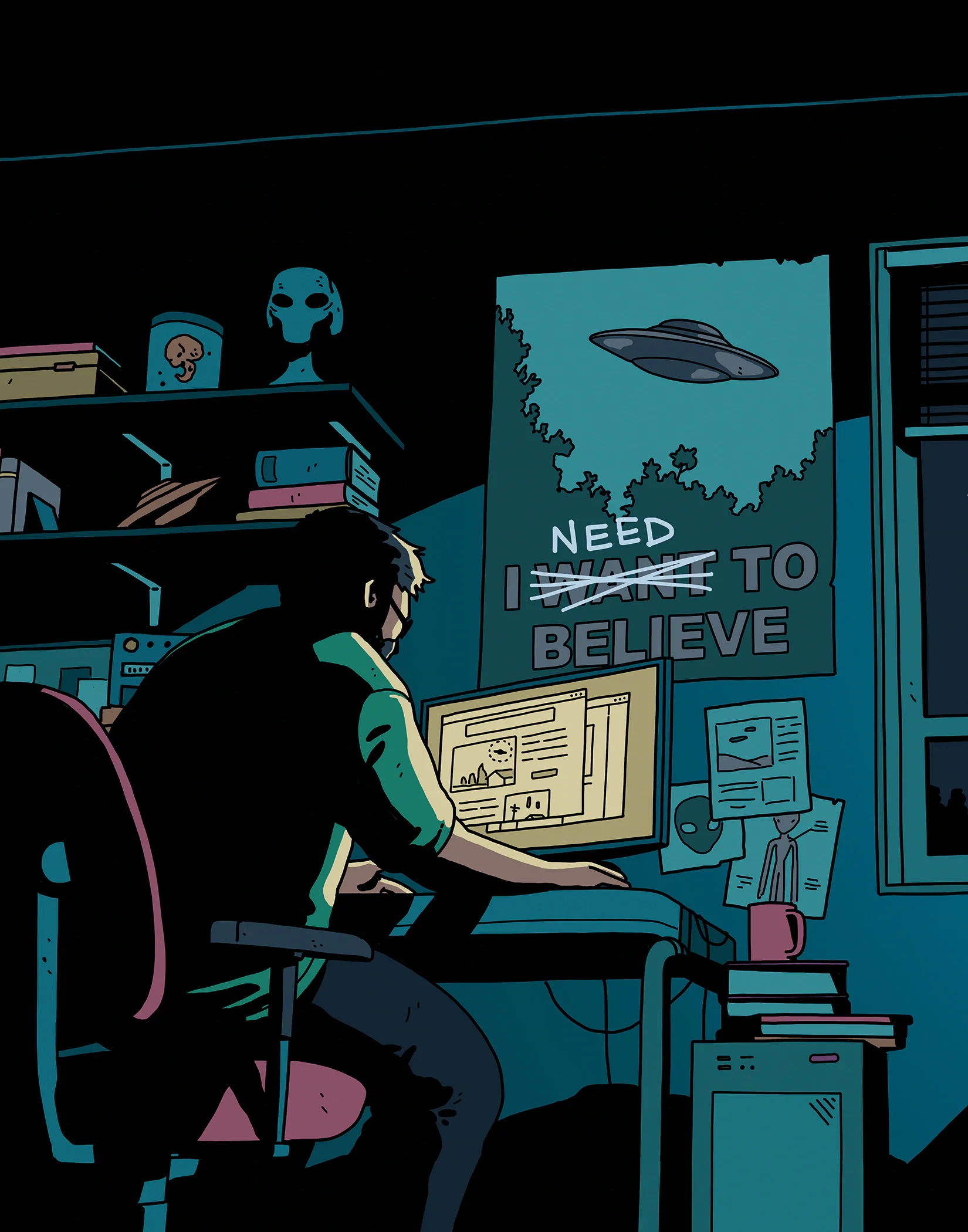
For decades, “UFOs” lived in America’s cultural basement—late-night radio, shaky camcorder clips, and the kind of conversations people lowered their voices to have. Then something shifted. The language got cleaner (“UAP,” not UFO), the venues got more respectable (Congress, not conventions), and the witnesses got more credentialed (military pilots, intelligence officials, and government contractors, not just hobbyists).
To a lot of people, that “upgrade” in legitimacy feels like a signal: *We’re finally getting the truth.* But the most sober read of the last few years is simpler—and, in a way, more revealing.
The UAP story is not primarily a story about visitors from another planet. It’s a story about how modern institutions process uncertainty, how attention warps incentives, and how human beings hunger for meaning when older frameworks of meaning weaken.
How we got here
The new wave didn’t start with a single smoking-gun photograph. It started with something more powerful: “official attention.”
When the public hears that the Pentagon studied unexplained aerial encounters, the mind does what minds do—it fills in blanks with drama. “Secret program” becomes “secret truth.” “Unidentified” becomes “alien.” And a topic that used to be dismissed as unserious starts to feel like a locked room someone important has entered. Then came hearings, interviews, documentaries, podcasts, and a steady stream of “I can’t tell you what I know, but…” statements—an irresistible format for the modern attention economy. The most viral kind of claim is the one that gestures toward evidence while keeping it just out of reach.
That doesn’t automatically mean anyone is lying. It means the system is built to amplify ambiguity. “Unidentified” doesn’t mean “unexplainable”
A hard truth: most “UAP” cases are not mysterious because the object is extraordinary. They’re mysterious because the data is incomplete.
A distant light at night, captured on a low-resolution sensor, viewed through moving glass, interpreted by a moving human brain—this is a perfect recipe for misperception. Add unusual weather, atmospheric distortion, glare, camera artifacts, and the fact that pilots and observers are often making split-second interpretations under stress, and you get a basic reality: the sky creates illusions easily. And even when instruments are involved, sensors have quirks. A camera can be fooled by zoom and stabilization. Radar can be fooled by clutter and anomalous returns. Two imperfect systems “agreeing” can still be two imperfect systems agreeing on the same mistake.
None of this is a dunk on witnesses. It’s the opposite: it takes human perception seriously enough to admit its limits.
The three broad explanations
Most UAP explanations fall into three buckets:
1. Ordinary things seen under unusual conditions
Commercial aircraft, balloons, drones, satellites, atmospheric phenomena, optical effects, misread distances and speeds—mundane objects made strange by context.
2. Advanced terrestrial tech
Secret testing, classified platforms, or novel drones—sometimes domestic, sometimes foreign.
3. Extraterrestrial intelligence
The big one: a non-human technology operating in Earth’s airspace.
People jump to #3 because it’s the most cinematic. But probability doesn’t care about cinema.
Bucket #2: “Foreign tech did it” is possible—but usually overstated. Yes, countries spy. Yes, militaries develop classified systems. But the wilder UAP claims often describe performance that would require not just better engineering, but a leap across entire eras of physics, materials, propulsion, and energy—the kind of leap you can’t hide because it would reshape everything else that touches it.
Breakthroughs leave footprints: supply chains, patents, industrial capacity, academic chatter, parallel advances. A technology that is “centuries ahead” doesn’t arrive as one clean object in the sky; it arrives as a revolution across multiple domains.
That doesn’t mean every strange case is “nothing.” It means “foreign super-tech” is not the default answer people think it is.
Bucket #3: Aliens are not impossible—just astronomically unlikely. The universe is big. Life elsewhere is plausible. But the step from “life exists” to “life traveled here” is enormous. Even if advanced civilizations exist, the distances involved make routine visitation a high bar. And the evidence usually offered to support alien presence tends to be the weakest kind of evidence: grainy images, ambiguous videos, secondhand testimony, and claims that can’t be tested publicly.
Extraordinary claims aren’t rejected because they’re exciting. They’re rejected because they demand extraordinary evidence—and ambiguity isn’t evidence.
Why the alien idea keeps returning
The most interesting question isn’t “Are they here?” It’s: “Why do we want them to be?” At a psychological level, alien narratives often function like a modern substitute for older religious stories—without requiring religion. Think about what many people want the cosmos to be:
That someone powerful knows we’re here
That someone is watching
That someone understands the mess we’ve made
That someone might intervene—or “reveal” the truth—at the last moment
That’s not just science-fiction longing. It’s a form of hope. It’s a secular salvation story: the universe has an intelligence, and we are not alone in our confusion. When traditional belief declines, the human need for meaning doesn’t decline with it. It migrates. Sometimes it migrates into politics, sometimes into ideology, sometimes into wellness culture, sometimes into conspiracy—and sometimes into the sky.
So what should a serious person do with UAP claims? Take them seriously in the correct way.
Document and investigate unusual cases—especially around sensitive sites—because security matters.
Demand transparent standards**: What data exists? What was the sensor? What are the error bars? What alternative explanations were ruled out?
Separate “unidentified” from “unexplainable.”
Reward evidence.
The healthiest posture is neither ridicule nor worship. It’s disciplined curiosity.
The conclusion
UAPs are real in the minimal sense: people see things they can’t immediately identify. Some of those things will remain unresolved, because the evidence is poor or classified or lost. But the leap from “unidentified” to “aliens” is where reason tends to evaporate. If there’s a mystery worth staring at, it’s not necessarily the lights above us. It’s the longing inside us—the hunger for an intelligence that might finally make the world feel coherent, supervised, and meaningful. And that hunger, whether we admit it or not, has always been part of the human story.